



The Five-Masted Bark "R.C. Rickmers": The Engineering Masterpiece and Its Tragic Fate
At the beginning of the 20th century, as the era of the commercial sailing fleet was rapidly hurtling toward its twilight, the German shipping dynasty of the Rickmers family decided on a bold experiment. Instead of completely abandoning sails in favor of steam, they chose to combine both technologies to achieve the absolute maximum.
Thus, in 1906, the "R.C. Rickmers"—a colossal five-masted steel bark—was launched at the Geestemünde shipyard in Bremerhaven. It entered an elite club consisting of only six five-masted vessels with direct square rigging ever to have existed in the world.
The ship's main technical trump card was an auxiliary triple-expansion steam engine delivering 1,160 horsepower. For a sailing vessel 146 meters long and with a displacement of over 10,500 tons, this was a rather modest engine. However, the goal was never to develop high speed; instead, there was an obvious practical benefit.
In the 80s and 90s, I sailed on supply vessels, super-Atlantics, and refrigerated transport ships. Only the supply vessels could enter ports and berth independently without any outside assistance. As for fishing boats, despite their short length—just over 80 meters—this type of vessel was always towed into open waters and brought to the pier by harbor tugs. The whole problem was that at dead slow speed, maneuverability drops drastically—the rudder simply "stalls" without a strong flow of water from the propeller, the vessel begins to yaw, and without thrusters, the maneuver is impossible.
Now, imagine a giant over 140 meters long entering a harbor, maneuvering, and mooring entirely on its own. The owners completely crossed the "harbor tug fees" line out of their expenses. Yes, the "R.C. Rickmers" entered ports by itself, under its own engine. In fact, it was for this very reason that the engineers sacrificed valuable cargo space in the holds to install the engine and coal bunkers. But there is a crucial technical nuance here.
Design and Technical Sophistication
Yet, in 90% of cases during fair weather, the company saved significant funds by fundamentally refusing tug services. This was achieved through two brilliant engineering solutions:
***
Total Optimization by the Shipowner (Capitalism vs. State Planning)
In the Ministry of the Maritime Fleet and the Ministry of the Fishing Industry of the USSR, safety always came first. If the regulations required taking a tug, the captain was obliged to take one; the state footed the bill.
In 1906, the Rickmers company operated on purely commercial logic: paying harbor tug fees for a vessel of this size consumed up to 20-30% of the voyage profits. The captain of the sailing ship had ironclad instructions from the shipowner: "Wherever possible—moor on your own."
On the "R.C. Rickmers," the auxiliary engine was used as a powerful "kick." The captain would enter the harbor on inertia, work the engine at dead slow ahead to maintain steering control via the massive rudder, while the sailors in longboats carried mooring lines to the pier ahead of time. After that, the ship would haul itself in using its own powerful steam capstans (winches). It was a huge risk that demanded jeweler-like precision and mastery from the German captains, but the economic savings more than justified the hazard.
When a favorable ocean breeze was caught, the "Rickmers" would douse its furnaces, unfurl its 6,045 square meters of canvas, and transform into a purebred windjammer, hitting an impressive 15–16 knots. Moreover, due to a system of steam winches, a crew of just 52 men was required to manage this entire massive setup.
Metrics of the Steel Giant:
***
Masters of the Bridge: The Captains of the "R.C. Rickmers"
Commanding a five-masted behemoth was a nightmare for a traditional old-school captain. Due to the colossal scale of the rigging, tacking (turning into the wind) carried an immense risk that the yards of adjacent masts might interlock and snap the entire gear. Only the absolute elite were allowed onto the bridge of the "Rickmers."
During its service under the German flag, three men commanded the vessel:
August Walsen — The First Captain.
He was the one who took delivery of the ship at the yard and led her on her maiden voyage from New York to Saigon in a record-breaking 83 days. Walsen squeezed the absolute maximum out of the hybrid concept: during the first two and a half years, he covered over 100,000 miles on the bark across the globe.
Herman Bandelin — The Inspector Captain.
He represented the interests of the Rickmers company owners during the most challenging passages. He is famous for an amusing incident during a transatlantic voyage to New York: Bandelin allowed the shipowner's 20-year-old daughter, Renée Rickmers (after whom another of the company's four-masted barks was named), to take the helm. As a result, the massive five-masted vessel entered the American harbor under the control of a young woman, causing a sensation in the press.
Here, I would like to make a brief remark. The bark lacked modern wheelhouses and control joysticks. Picture a massive steering wheel being turned with great effort by a pair of burly helmsmen. Now, imagine a fragile twenty-year-old beauty whom the officers simply could not refuse. Can you picture it? That is exactly how I see it: the girl courageously steering the vessel into port, assisted at the secondary wheel by sweating sailors, amidst the joyful smiles of the navigation officers who were thrilled to give the owner's daughter the pleasure of holding the wooden spokes. This is no sarcasm. I am genuinely, humanly happy for her, and had I been in those officers' shoes, I would have certainly done the exact same thing.
Captain Schwetman — The Last German Master.
He took command just before the war. In 1914, Schwetman completed a grueling 98-day passage from Vladivostok to England with a cargo of grain, arriving literally a couple of weeks before the outbreak of hostilities. He brought the vessel straight into Cardiff, completely unaware that this port would become a trap for the German crew and that the bark itself would be confiscated by the British.
The Final Chapter
The First World War caught the "R.C. Rickmers" in the port of Cardiff (Wales). The British Admiralty, without much ceremony, requisitioned the German masterpiece as a prize of war, renamed it the "Neath," and put it to work hauling cargo for the needs of the Entente.
The denouement came on March 27, 1917. The massive sailing ship, carrying a cargo of sugar from Cuba to England, was intercepted off the coast of Ireland by the German submarine U-66. The submarine's commander, acting under the rules of unrestricted submarine warfare, ordered the crew to abandon ship, and only then sent a torpedo into the giant's hull. The former pride of German engineering sank at the hands of her own countrymen.
***
Author’s Note: This article is an exclusive, deeply revised, and expanded version of the original narrative. For context, I am the original author who researched, drafted, and published the comprehensive history of the "R.C. Rickmers" on Wikipedia back in 2010. This current release features my unique seafaring analysis, personal archival notes, and professional insights, making it the definitive and most accurate account available today.
At the beginning of the 20th century, as the era of the commercial sailing fleet was rapidly hurtling toward its twilight, the German shipping dynasty of the Rickmers family decided on a bold experiment. Instead of completely abandoning sails in favor of steam, they chose to combine both technologies to achieve the absolute maximum.
Thus, in 1906, the "R.C. Rickmers"—a colossal five-masted steel bark—was launched at the Geestemünde shipyard in Bremerhaven. It entered an elite club consisting of only six five-masted vessels with direct square rigging ever to have existed in the world.
The ship's main technical trump card was an auxiliary triple-expansion steam engine delivering 1,160 horsepower. For a sailing vessel 146 meters long and with a displacement of over 10,500 tons, this was a rather modest engine. However, the goal was never to develop high speed; instead, there was an obvious practical benefit.
In the 80s and 90s, I sailed on supply vessels, super-Atlantics, and refrigerated transport ships. Only the supply vessels could enter ports and berth independently without any outside assistance. As for fishing boats, despite their short length—just over 80 meters—this type of vessel was always towed into open waters and brought to the pier by harbor tugs. The whole problem was that at dead slow speed, maneuverability drops drastically—the rudder simply "stalls" without a strong flow of water from the propeller, the vessel begins to yaw, and without thrusters, the maneuver is impossible.
Now, imagine a giant over 140 meters long entering a harbor, maneuvering, and mooring entirely on its own. The owners completely crossed the "harbor tug fees" line out of their expenses. Yes, the "R.C. Rickmers" entered ports by itself, under its own engine. In fact, it was for this very reason that the engineers sacrificed valuable cargo space in the holds to install the engine and coal bunkers. But there is a crucial technical nuance here.
Design and Technical Sophistication
- The power was sufficient for maneuvers: The aforementioned steam engine could propel this massive structure up to 6–8 knots in calm water. This was more than enough to weigh anchor without outside help, enter the crowded harbor of New York, turn around on the waterway, and neatly approach the pier.
- The exception—gale-force winds: The only situation when the "Rickmers" did request assistance was a strong crosswind right inside the harbor. Due to the colossal height of its five masts, the ship possessed immense windage from both the hull and the rigging (it was simply blown sideways). In such weather, it was difficult for the weak engine to keep the giant from slamming into the pier, and that was when harbor tugs would step in to back it up.
Yet, in 90% of cases during fair weather, the company saved significant funds by fundamentally refusing tug services. This was achieved through two brilliant engineering solutions:
- A colossal rudder blade: Sailing ships were designed to answer the helm even with minimal headway. Its rudder blade was enormous to keep the 146-meter hull on course.
- A two-bladed propeller: The propeller shaft turned a heavy, large-diameter two-bladed screw. At low revolutions, it delivered a powerful, dense thrust of water directly onto this gigantic rudder blade. The vessel could literally "spin on a dime" compared to modern motor ships.
***
Total Optimization by the Shipowner (Capitalism vs. State Planning)
In the Ministry of the Maritime Fleet and the Ministry of the Fishing Industry of the USSR, safety always came first. If the regulations required taking a tug, the captain was obliged to take one; the state footed the bill.
In 1906, the Rickmers company operated on purely commercial logic: paying harbor tug fees for a vessel of this size consumed up to 20-30% of the voyage profits. The captain of the sailing ship had ironclad instructions from the shipowner: "Wherever possible—moor on your own."
On the "R.C. Rickmers," the auxiliary engine was used as a powerful "kick." The captain would enter the harbor on inertia, work the engine at dead slow ahead to maintain steering control via the massive rudder, while the sailors in longboats carried mooring lines to the pier ahead of time. After that, the ship would haul itself in using its own powerful steam capstans (winches). It was a huge risk that demanded jeweler-like precision and mastery from the German captains, but the economic savings more than justified the hazard.
- Combating dead calms: In the doldrums of the ocean, where conventional windjammers could drift for weeks, this monster would fire up its boilers and forge ahead at a speed of 6–7 knots.
- Retractable propeller: The most elegant solution of the entire design. To prevent the propeller from dragging and creating water resistance when the bark was running under sail, it was ingeniously raised coaxially inside the hull into a special watertight well.
When a favorable ocean breeze was caught, the "Rickmers" would douse its furnaces, unfurl its 6,045 square meters of canvas, and transform into a purebred windjammer, hitting an impressive 15–16 knots. Moreover, due to a system of steam winches, a crew of just 52 men was required to manage this entire massive setup.
Metrics of the Steel Giant:
- Length Overall: 146 meters
- Beam: 16.3 meters
- Maximum Displacement: 10,500 tons
- Sail Area: 6,045 sq. m (42 sails)
- Powerplant: Auxiliary steam engine + retractable propeller
***
Masters of the Bridge: The Captains of the "R.C. Rickmers"
Commanding a five-masted behemoth was a nightmare for a traditional old-school captain. Due to the colossal scale of the rigging, tacking (turning into the wind) carried an immense risk that the yards of adjacent masts might interlock and snap the entire gear. Only the absolute elite were allowed onto the bridge of the "Rickmers."
During its service under the German flag, three men commanded the vessel:
August Walsen — The First Captain.
He was the one who took delivery of the ship at the yard and led her on her maiden voyage from New York to Saigon in a record-breaking 83 days. Walsen squeezed the absolute maximum out of the hybrid concept: during the first two and a half years, he covered over 100,000 miles on the bark across the globe.
Herman Bandelin — The Inspector Captain.
He represented the interests of the Rickmers company owners during the most challenging passages. He is famous for an amusing incident during a transatlantic voyage to New York: Bandelin allowed the shipowner's 20-year-old daughter, Renée Rickmers (after whom another of the company's four-masted barks was named), to take the helm. As a result, the massive five-masted vessel entered the American harbor under the control of a young woman, causing a sensation in the press.
Here, I would like to make a brief remark. The bark lacked modern wheelhouses and control joysticks. Picture a massive steering wheel being turned with great effort by a pair of burly helmsmen. Now, imagine a fragile twenty-year-old beauty whom the officers simply could not refuse. Can you picture it? That is exactly how I see it: the girl courageously steering the vessel into port, assisted at the secondary wheel by sweating sailors, amidst the joyful smiles of the navigation officers who were thrilled to give the owner's daughter the pleasure of holding the wooden spokes. This is no sarcasm. I am genuinely, humanly happy for her, and had I been in those officers' shoes, I would have certainly done the exact same thing.
Captain Schwetman — The Last German Master.
He took command just before the war. In 1914, Schwetman completed a grueling 98-day passage from Vladivostok to England with a cargo of grain, arriving literally a couple of weeks before the outbreak of hostilities. He brought the vessel straight into Cardiff, completely unaware that this port would become a trap for the German crew and that the bark itself would be confiscated by the British.
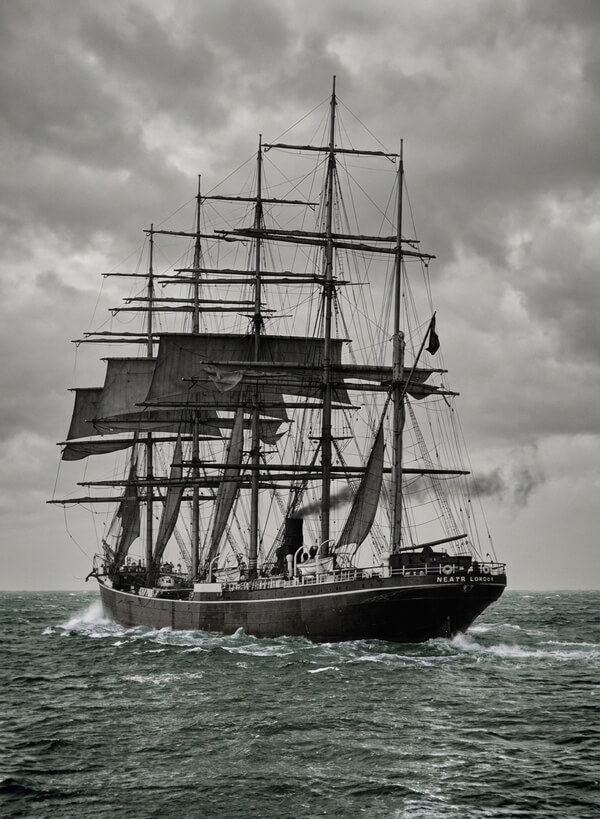
The Bark "R.C. Rickmers" after renaming, in the service of England.
The Final Chapter
The First World War caught the "R.C. Rickmers" in the port of Cardiff (Wales). The British Admiralty, without much ceremony, requisitioned the German masterpiece as a prize of war, renamed it the "Neath," and put it to work hauling cargo for the needs of the Entente.
The denouement came on March 27, 1917. The massive sailing ship, carrying a cargo of sugar from Cuba to England, was intercepted off the coast of Ireland by the German submarine U-66. The submarine's commander, acting under the rules of unrestricted submarine warfare, ordered the crew to abandon ship, and only then sent a torpedo into the giant's hull. The former pride of German engineering sank at the hands of her own countrymen.
***
Author’s Note: This article is an exclusive, deeply revised, and expanded version of the original narrative. For context, I am the original author who researched, drafted, and published the comprehensive history of the "R.C. Rickmers" on Wikipedia back in 2010. This current release features my unique seafaring analysis, personal archival notes, and professional insights, making it the definitive and most accurate account available today.